The Billion Dollar Power Bill
How we can beat China in the AI Race.
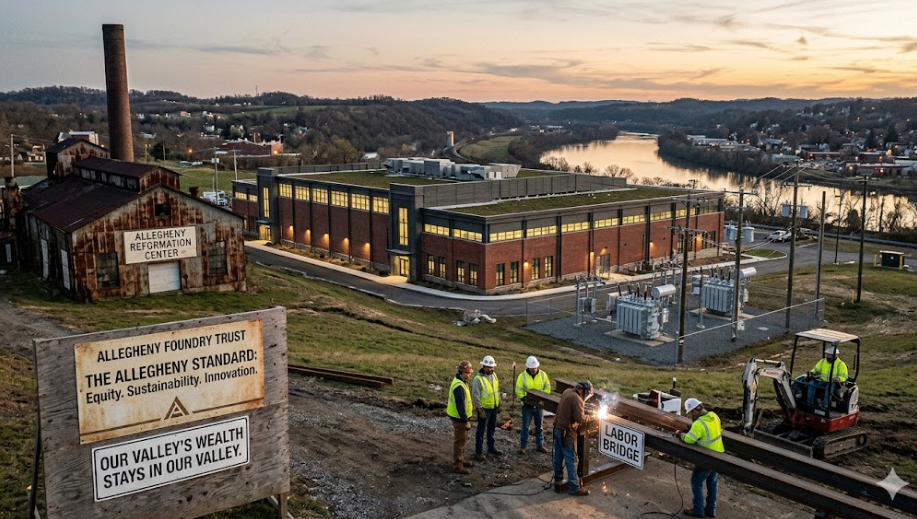
The Allegheny Standard Model; Equity + Sustainability = Innovation
Right now, big tech is looking at Western Pennsylvania like it’s an untapped gold mine. You’ve probably seen the headlines or heard the rumors about massive "data centers" moving into the Allegheny Valley. These aren't just offices; they are giant warehouses filled with thousands of roaring computers that act as the brain for the world’s AI. They are hungry for two things we have in spades: land and electricity.
Michael Dell, the guy whose name is on half the computers in the world, recently came out against a proposal to put a "pause" on these builds. He says we’re in a global race and we can’t afford to slow down. He isn’t entirely wrong. If the United States stops building, we lose our edge to countries like China that are moving at light speed. But there is a massive problem with his "full speed ahead" logic that he isn't mentioning over his morning espresso.
Our local power grid is like an old bridge it can only hold so much weight before it collapses. If these companies floor the gas without reinforcing the bridge, they won’t just blow their own fuses; they’ll leave the rest of us sitting in the dark with higher electric bills.
The Grid is the New Gold
The reason these CEOs are eyeing our backyard is simple. We have the infrastructure to move power, but we don't have the modern hardware to support the sheer volume these AI "factories" require. In his recent interviews, Dell admitted that energy is the biggest bottleneck to the future of tech. He knows they need massive amounts of juice to keep those servers from melting down. But here is the reality check:
when a multi-billion dollar company plugs into a local substation, they are consuming a public resource that was built and maintained by the people living here.
If we just roll out the red carpet and let them plug in for free, we are effectively subsidizing their profits with our own stability.
We’ve seen this movie before in Western PA.
A big industry comes in, extracts what it needs, and leaves us with the rust when they find a cheaper spot. To win the global AI race, we don’t need a pause, but we also can't afford a handout. We need a solid, fair exchange.
The Allegheny Standard
I’ve been calling this the Allegheny Standard (link to original article). It’s a simple rule: if you want to build a ten-billion-dollar computer warehouse in our valley, you put 12% of that project cost into a local trust. That isn't a "tax" or "red tape." It is a down payment on the very resources the company is about to use. If Dell needs a reliable power grid to win the race against China, then he should be the one helping to pay for the transformers and line upgrades that make his business possible.
By mandating that 70% of those funds stay within ten to fifteen miles of the building site, we ensure the money actually hits the ground where the impact is felt.
This money goes to the local power grid so your lights don’t flicker when their servers kick on. It goes to the volunteer fire departments who have to learn how to handle high-tech electrical fires. It ensures that the "AI Factory" isn't just a neighbor that takes; it’s a neighbor that builds.
Building the Labor Bridge
One of the biggest corporate myths is that these centers bring thousands of local jobs. The truth is, once the building is finished, they are mostly run by a small crew of techs. The Allegheny Standard changes that by funding the Labor Bridge. We use that trust money to fund local trade schools and training programs for "AI-proof" skills like heavy machine operation and electrical engineering. But we go further. This isn't just about turning a wrench; it’s about bolstering the entire robotics industry right here in the valley.
The trust provides grants for advanced AI courses and tech-heavy college programs, ensuring our kids aren't just users of the tech, but the ones building and fixing the robots that run inside those centers. By training our own people to master the physical and digital realities of these facilities, we create a workforce that can't be outsourced. This is how we keep the "American Edge."
We turn the Allegheny Valley into a partner in the industry, not just a host for a server farm.
Manufacturing the Local Engine
If we have the power, the facilities, and the trained labor, the final piece of the puzzle is bringing the business back home. The Allegheny Standard uses its funds to provide "Renaissance Grants" for local startups and not just in tech. We’re talking about the diners, the hardware stores, and the machine shops that form the backbone of our towns.
By providing seed capital for local entrepreneurs, we ensure that the wealth generated by a data center bleeds into the entire community.
This creates an "immersion economy." When you have a massive data center anchored in a town with a trained workforce and a subsidized local business district, you attract other companies to move in. You don't have to beg for jobs to come back to PA; you build an environment where they have no choice but to come here because we have the only "ready-to-go" ecosystem in the country. It transforms the region from a site of industrial extraction into a hub of homegrown innovation.
Do the Work or Don't Build
At the end of the day, this is about sovereignty.
We control the ground they need to build on. We have the leverage to demand a deal that respects our families and our future. The tech race is important, but it shouldn't be run at the expense of the people living on the front lines. We can have the innovation, the data centers, and the global lead, but only if we demand the exchange upfront.
The blueprint is right here. We don't need to chase the tech away, and we certainly don't need to give it away for free. We demand the 12%,
we build the trust, and we make sure that the wealth generated in this valley actually stays in this valley. Do the work, or don't post the plans. Let's build the future on our own terms.
