Why Miyazaki is Wrong
And Why I Use His Style
By Chris Kilgore | Rebis Global
The air in Pittsburgh PA, is heavy with the smell of spring and fresh coffee. I’m sitting at my workbench, watching a progress bar crawl across the screen while the rest of the house sleeps.
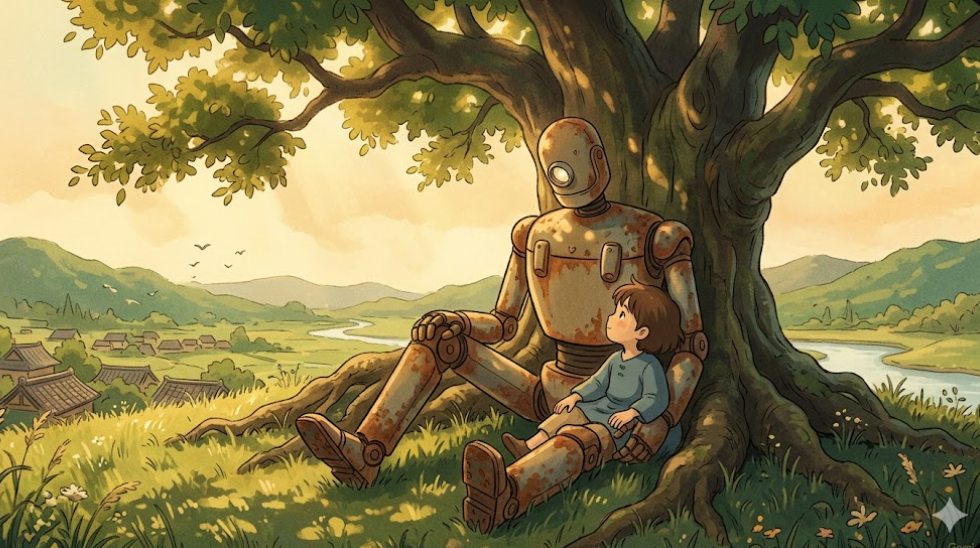
I am iterating on a single frame: a weathered machine and a child sitting together under the shade of a massive camphor tree. The light isn’t "digital" or "rendered" it’s that specific, dusty gold that only exists in the memory of a summer afternoon.
I recently dropped a "billboard" comment on a viral anti-AI thread from my brand page, Rebis AI Lab. I didn't argue with the critics; We agreed with them. We validated their fear of a soulless future and walked away, because they aren't actually afraid of the tool. They are afraid of a world where the human intent has been replaced by a "randomize" button.
The Fallacy of the Autonomous Brush
Hayao Miyazaki famously called AI animation an "insult to life itself." He saw a demonstration of a digital creature crawling with no sense of pain or purpose, and as a master of his craft, he was right to recoil.
What he saw was the Nigredo the raw, messy, and often grotesque state of a technology that didn't yet have a pilot. The current state of the current AI debate Hype, Fear, and a Lack of Literacy, has led people to believe that the machine is the artist. This is a fundamental misunderstanding of the work. A tool is only as dangerous, or as beautiful, as the hand that holds it. If you give a pencil to a toddler, you get a scribble on the wall; Put that same pencil in the hand of a master, and it creates wonders. AI is no different. There is no "free" gain in this lab; there is only an exchange. If you give a lazy, three-word prompt, the machine gives you a plastic, hollow image. To find the warmth of a sun-drenched gradient, you have to exchange your own time, your own eye, and your own soul to guide the machine toward something that actually breathes.
Why Anime is the Language of Alignment
At Rebis Global, we don't use the sterile, neon-blue aesthetic that defines Silicon Valley. That look is built on corporate hype and cold, calculated logic.
We have deliberately chosen a Ghibli-inspired framework because it is the most effective visual language for Human Alignment. While Western media often defaults to "Terminator" doom-mongering, the lineage of anime has spent decades showing us that a harmonious existence between machine and man is not only possible but beautiful.
In these stories, the robot isn't a replacement for the soul; it is often a protector of it. By choosing warm, earthy, and inviting palettes, we are performing a "cut through" of the digital noise. We aren't trying to show you how powerful the technology is we are showing you how human it can feel when it is aligned correctly. It takes a human eye to know if a color gradient feels "right." The machine can calculate hexadecimal codes, but it cannot calculate nostalgia or the weight of a quiet moment. That is the work of the Architect: distilling the chaos of the "Infinite Variable" into a scene where the human presence is felt in every pixel.
The Rebis Standard and a Debt of Honor
The era of the "User" is dying, and the era of the Intent is here. We use this style because it demands heart. It demands that you look past the code and see the relationship between the creator and the creation. We are showing the world that you can have the machine and the soul in the same frame, but only if you are willing to do the work. Understanding the tool is the first step toward purifying the work.
In closing, we have to look back at the giants whose shoulders we stand upon. To Hayao Miyazaki and the incredible artists of Studio Ghibli: Thank you. You taught a generation how to see the magic in the mundane and the spirit in the mechanical. You gave us a vision of a world where nature, humanity, and technology could exist in a delicate, respectful balance. While we may differ on the tools of the new era, our goal remains the same—to capture the warmth of the human spirit and ensure it is never lost to the coldness of the void. We honor the master by continuing the work, ensuring that even in a world of silicon and code, the light can remain golden.
Understand the tool. Do the work or don't post it.
