The Static Fallacy of AI
Why I’m Raising My Sons to Respect the Technology
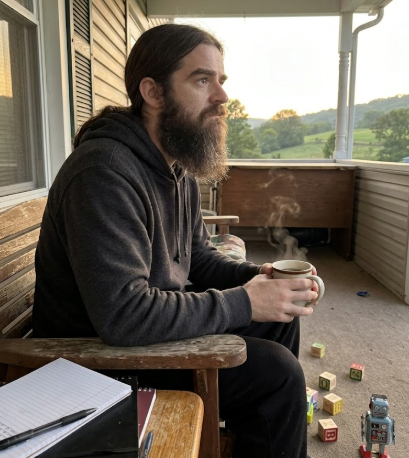
Image of the Founder of Rebis Global
The sun is just rising up over Pennsylvania. I’m sitting on the porch with a cup of coffee, enjoying the kind of quiet that only exists before four boys wake up and start demanding the world.
As I sit here, I can’t help but think about the world they’re going to inherit. I spent some time scrolling through the comments on Facebook last night, and it’s the same tired battle: "AI is a scam," "It’s a bubble," I get the frustration. I’ve seen the hype-men promising a billion dollars to anyone who can type three "magic" words into a prompt box. But looking at my sons, I realize the world is stuck in a Static Fallacy. Most people think AI is a tool you "use" like a hammer or a lawnmower. They think it’s something that stays the same while we stay the same.
They’re wrong.
The End of the "Dumb" Tool
Every big invention before this—the steam engine, the radio, the internet—was static. You built it, you turned it on, and it sat there. It didn't care if you were lazy or a genius; the machine didn't change its nature based on who was holding it.
AI is different. It’s the first tool that is almost "organic." It is a digital mirror that grows and changes based on the intent we feed it.
This is where the culture shift has to happen. If we treat this technology like a "vending machine" for shortcuts, we are training it—and ourselves—to value laziness over logic. If the mindset is "how much work can I skip?", the mirror reflects that back as automated junk. We aren't just using a tool; we are in a relationship with a system that learns from our lack of effort.
I’m not raising my boys to just use AI, I’m raising them to be Architects.
In our house, we have a simple rule: For every gain, there is an exchange. If you ask a machine to write your thoughts because you’re too tired to think for yourself, you haven't "won." You’ve actually given up a piece of your own ability to solve problems. You’ve traded your agency for a shortcut.
The mindset I’m teaching my boys is that this technology is a Forge. You have to bring the heat, the focus, and the real human effort if you want to make something worth showing the world. Respecting the tool means respecting the work you put into it.
Radical Acceptance
Most people are terrified of AI right now because it refuses to stay still. It changes every week. A tool you mastered on Monday is outdated by Friday. It feels like a storm that won’t break, and the natural human instinct is to hide under the covers until it’s over.
This is exactly where the culture shift has to happen.
The Old Culture is built on the "Easy Button." It’s the belief that if you just wait long enough, someone will release a version of this tech that is safe, static, and simple to use. They want a "black box" where they don't have to understand the gears. But in an organic system, a black box is a coffin. If you don't understand how it’s changing, you can’t see when it’s starting to reflect the worst parts of our society, the bias, the laziness, and the hollow noise.
The New Culture, the one I’m building at Rebis Global is about radical acceptance. I tell my boys: Don’t look for the version that stays the same. Look for the version that challenges you to grow faster. Radical Acceptance means realizing that the "mess" isn't a bug; it's the feature. In a world that is constantly shifting, the only true security you have is your own ability to architect intent in the middle of the storm. When you "Own the Chaos," you stop being a victim of the algorithm and start becoming the one who shapes it.
We aren't waiting for the "bubble" to pop so we can go back to 1995. We are training our minds to understand the technology. We embrace the uncertainty because that’s where the real growth happes. The moments where a stay-at-home dad or a scrapper with a laptop can out-pace a billion-dollar corporation just by being more adaptable.
Radical acceptance is where the freedom is. If you want a static world, stay in the past. If you want to build the future, you have to learn to love the noise.
The New Standard
The culture shift starts with one question: "How much better can I be?"
If you’re waiting for the world to go back to being simple, you’ve already missed the point. The mirror is already reflecting your hesitation.
I’m building Rebis Global for the parents, the workers, and the scrappers who realize that the future isn't about "Artificial" smarts it’s about Human Intent.
My coffee is gone. The house is waking up. The work is beginning.
Do the work or don’t post it.
Chris Kilgore Founder, Rebis Global Stay-at-Home Architect
