Shifting Landscape
Why the AI "Big Three" Realignment is the Best Thing for the Rest of Us
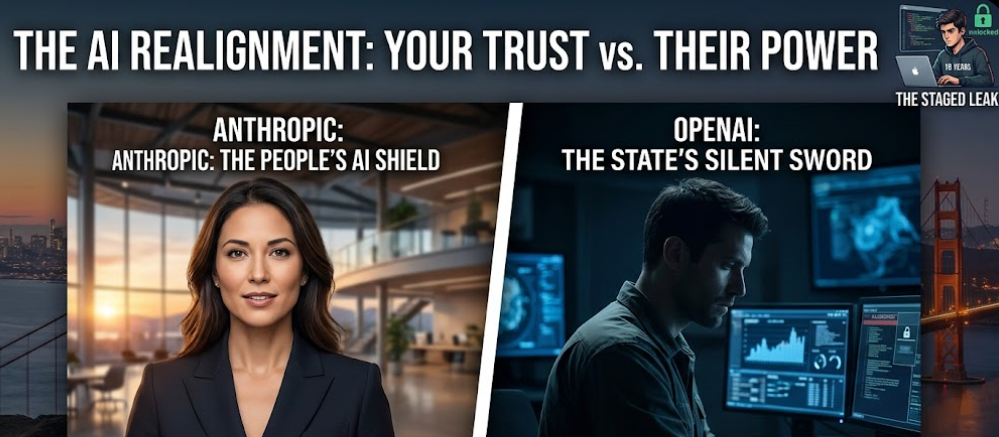
image created with gemini
The Staged "Glitch"
The "staged" leak involving an 18-year-old researcher finding a vulnerability is a masterclass in managed disclosure. In the world of high-stakes software, these "accidents" often serve as a controlled pressure release to demonstrate a system’s resilience. By allowing a public, non-threatening figure to "discover" a flaw that is then patched within a 24-hour cycle, Anthropic effectively cements its image as the responsible, safety-first adult in the room. This isn't a failure of security; it's a strategic branding exercise designed to build a "regulatory moat." By leaning so hard into Constitutional AI and safety-led PR, they are effectively helping the government write the rules of the game. Rules that they already follow, which conveniently raises the overhead for any smaller scrapper trying to enter the field.
This shift has turned Anthropic and Google into the dominant duopoly for the private sector and the "People’s AI." specifically Anthropic’s "Constitutional" play is a calculated trade: they have walked away from certain high-level military contracts to maintain a "clean" brand for the civilian and enterprise markets. Even as the U.S. government labels them a "supply chain risk" for defense work, they’ve successfully positioned themselves as the trusted utility for everyone else.
While Google provides the massive infrastructure and "pipes" of the AI world, Anthropic provides the "Shield" the ethical, aligned layer that businesses feel safe integrating into their daily lives.
On the other side of the board, OpenAI is undergoing a total break down into the state apparatus. They aren't being "squashed" in the traditional sense; they are being absorbed by the military-industrial complex to become its "Sword." The recent deployment of GPT models onto classified military networks for war-gaming and battlefield simulations marks their transition from a public-facing research lab to a silent government entity. The high-profile resignation of their Head of Robotics over "lethal autonomy" concerns is the final proof of this trajectory. OpenAI is no longer a startup competing for your chat history; they are an intelligence layer for the Pentagon, leaving the consumer space wide open for those who chose a different exchange.
Meanwhile, Nvidia has pivoted entirely toward the "Physical AI" landscape, moving the goalposts from digital chat to mechanical reality. With the launch of Cosmos 3, they have signaled that their true interest lies in robotics and the foundation models that power them. They aren't interested in winning the "vibe" war or the chatbot race; they want to be the nervous system for every humanoid robot and automated factory on the planet. For the architect, the board is finally clear:
OpenAI is the Sword of the state, Anthropic is the ethical Shield of the people, Google is the ecosystem, and Nvidia is the Hand that moves the world.
The "Pigeon-Penguin Problem" of treating AI as one giant, confusing mass is over, and the era of specialized, functioning systems has begun.
