Part 3-Global Executive Brief
The Allegheny Standard as a Protocol for Capital Resilience in the Age of Democratized AI
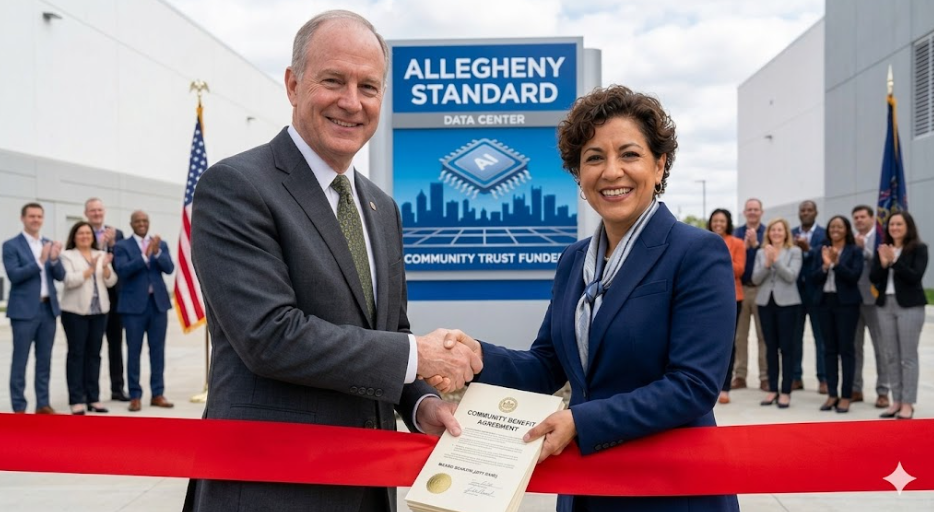
Setting a new standard for the future
TO: Chief Executive Officers, Institutional Investors, and Infrastructure Fund Managers
FROM: Rebis Global
DATE: April 17, 2026
SUBJECT: Mitigating the "Friction Tax": A New Framework for Global Data Infrastructure
I. THE GLOBAL REALITY: THE $156 BILLION CAPITAL LEAK
The "Old Playbook" of rapid land acquisition and proprietary development is no longer just inefficient, it is fiscally toxic. In 2025 alone, global opposition to data centers led to an estimated $156 billion in projects being blocked, suspended, or cancelled.
The Surge: US data center cancellations quadrupled in 2025, with 4.7 GW of planned capacity lost.
The Friction Tax: Between early 2025 and 2026, over 186 major projects were derailed by local opposition, leading to massive write-downs on "stranded capital."
The Diagnosis: Projects are failing because they ignore the Rule of Conservation. You cannot "take" gigawatts from a regional grid without a structured, ledger-backed "exchange" to the community.
II. DISARMING THE ASYMMETRY: THE "NIGHTMARE WEEKEND" VECTOR
In 2026, the corporate "Black Box" is a liability. The democratization of AI has ended the era of information monopoly.
The Reality: Any individual with a local LLM and OSINT tools can now create a "Shadow Ledger" of your facility’s environmental impact (water table depletion, thermal output, and grid stress) in a single weekend.
The Risk: When a community-generated "Shadow Ledger" contradicts your PR narrative, the resulting Credibility Gap triggers immediate regulatory freezes and ESG divestment.
The Solution: The Allegheny Standard. By voluntarily providing real-time data via a Community Trust API, you disarm the narrative. You transition from being the target of autonomous oversight to being the authoritative source of verifiable truth.
III. FIDUCIARY COMPLIANCE: CERTAINTY AS A SERVICE
Institutional investors now demand Asset Resiliency, not just growth. Vague ESG promises are being replaced by "Hard Accountability" metrics.
The Trust Ledger: Capital allocated via the Allegheny Standard is managed by an independent Community Trust.
The ROI: Your organization receives a Proof of Ledger—a verifiable data set of localized risk mitigation (utility reinforcement, STEM workforce pipelines, and acoustic barriers).
Fiduciary Win: This Ledger allows your IR (Investor Relations) team to present a project that is fiscally "purified" of the litigation risks that have claimed $156B in competitor assets.
IV. OPERATIONAL VELOCITY: THE "FAST-PASS" PROTOCOL
The most expensive line item in any 400MW+ project is Delay. As of 2026, permitting hurdles and community lawsuits (local grievances snowballing into class actions) jeopardize nearly 50% of global projects in the pipeline.
Consensus is Cheaper than Litigation: The Allegheny Standard is a Community Benefits Agreement (CBA) in a box.
The Exchange: By baking the solution into the project’s DNA, you eliminate the "Infinite Variable" of local politics. You trade a fraction of initial CapEx for an accelerated, frictionless operational timeline.
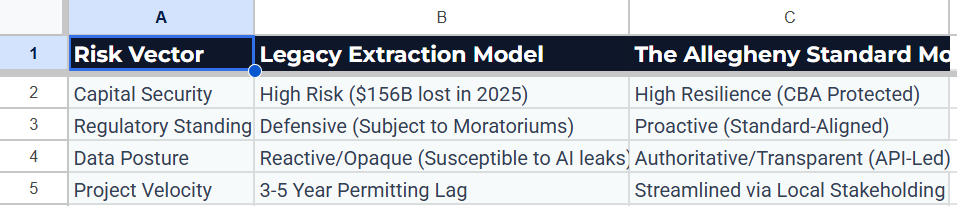
V. COMPARATIVE PERFORMANCE ANALYSIS
VI. FINAL MANDATE
Transparency is no longer a choice; it is an environmental constant enforced by the very AI tools you are building. You can either manage the "Exchange" via the Allegheny Standard and secure a Wealth of Longevity, or you can watch your project become another statistic in the next global cancellation report.
The machine is only as good as the human intent behind it. In 2026, the only "perfected work" is an asset that functions as a foundational partner to the community it inhabits.
Do the work, or let the friction take the ROI.
