Why a Fully Automated Future is a Nightmare
Not a Utopia
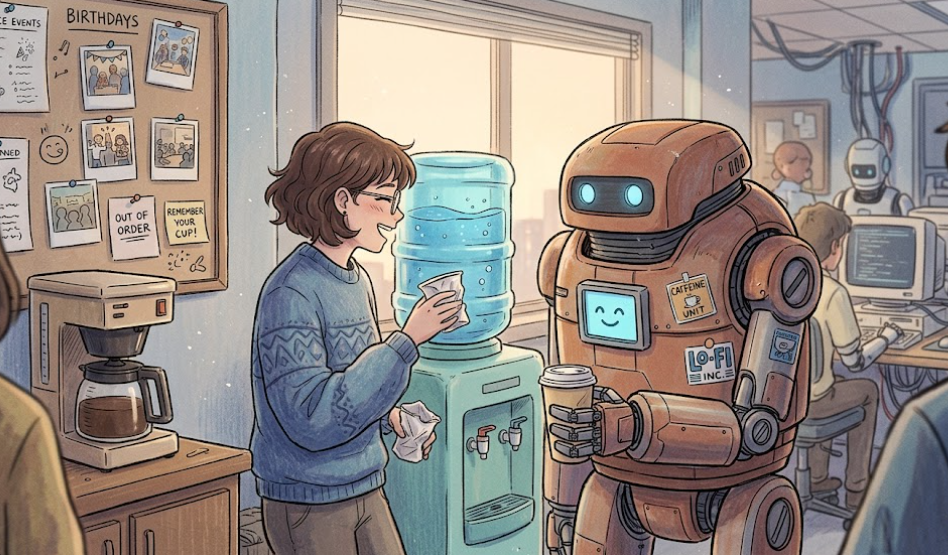
Shared workspace - image created with Gemini
The Silicon Valley hype machine has a favorite bedtime story. It goes something like this: AI will soon do all the "thinking." Robots will do all the "doing." We, the enlightened humans, will be freed from the "drudgery of work," occupying our days with leisure, philosophy, and endless creative pursuits.
It’s a seductive tale. But it's time to read between the lines. Because the "Wall-E" future they're selling us, where humanity is a race of pampered, redundant observers floating in anti-gravity chairs isn't a utopia. It's a psychological nightmare in disguise. This narrative is built on a fundamental misunderstanding of the human condition. It assumes that "effort" and "struggle" are bugs we need to patch out of our existence. But the reality is that the act of creation, and the grit of work, is not just what we do; it is who we are. To remove it is to remove the very mechanism by which we build purpose, competence, and meaning.
The Myth of Leisure as an End Goal
The problem starts with a flawed definition of happiness. The popular image of the automated future equates "leisure" with "idleness." We are led to believe that happiness is the removal of friction. The less we have to do, the happier we will be?
Psychology tells a different story. True fulfillment rarely comes from consumption; it comes from production. It comes from engaging with a challenge and emerging victorious, even if the "victory" is just a well-crafted line of code, a perfectly seasoned meal, or a garden bed free of weeds.
When you remove all struggle, you also remove the context required for victory. A victory that comes without effort is hollow. It's participation-trophy of happiness. If AI does the thinking, the resulting solution isn't ours. We've just become professional output-validators. We're not solving the puzzle; we're just reading the back of the box.
The Lesson of the 80-Year-Old
We don't need to look to a sci-fi future to see the consequences of removing meaningful work. We can see it right now in our own aging population. Consider the 80-year-old who hits a wall after retiring from a high-stakes corporate career. They have all the leisure they could want, and yet they are consumed by a sense of deep, crushing uselessness. Mass depression is sadly common in this demographic.
The "work" they lost wasn't just a task; it was their framework for engagement. It was their place in the collective. When they were working, they mattered. They had problems that needed their specific expertise. They had a reason to get up, think, and push.
“When that friction is gone, the self begins to atrophy.”
If the fully automated future is realized, we're not just creating a nation of retirees; we're creating a civilization that has involuntarily retired from the human project. We will have collectively agreed to become redundant.
Nigredo to Rubedo
In classical alchemy, the process of transformation required three key stages:
Nigredo (the blackening or decomposition), Albedo (the whitening or purification), and Rubedo (the reddening or perfection). This alchemical journey is the ultimate metaphor for human accomplishment.
You cannot have the Rubedo (the perfected work) without going through the Nigredo (the messy, frustrating, dirt-under-the-fingernails breakdown). The "grit" is not an unwanted side effect; it is the catalyst of transformation. The frustration of trying to get a system to work, the exhaustion of physical labor, the mental fog of a difficult coding problem that is the Nigredo. It’s where growth happens. It’s where our competence is forged.
The Silicon Valley promise is to skip the Nigredo entirely. They offer an instantly perfected Rubedo, generated on command. This seems efficient, but it’s a form of profound theft. If you automate away the struggle, you are stealing the achievement. You aren't creating a more enlightened populace; you are creating a more disconnected one.
The Conservation of Agency
The promise of automation always comes with a hidden cost: your agency. This is a form of the Rule of Conservation. You can choose to have all the complex work automated, but you must trade away your competence and choice in exchange.
The more AI does your "thinking," the less thinking you are capable of doing.
“Dependency is the opposite of agency.”
We are already seeing this. As our GPS-guided world removes the need to develop navigational skills, our collective sense of direction erodes. When the tools we rely on are black boxes we can't repair, we lose the understanding of how the world is actually constructed.
The automated future doesn't offer "freedom." It offers dependence. It invites us to become the cargo on this ride, not the crew. We are trading our ability to affect change for the comfort of having change managed for us.
Work is the Core of Connection
The final lie is that we can easily find meaning in "other" things. But what are those things? Relationships? Community? Even those require the shared effort of building something together. Meaning isn't a passive state you discover in a lounge chair. Meaning is actively forged through the effort of construction, creation, and problem-solving.
We don't just "have" a life; we build a life. We find our connection to other people, and to the physical world, through the friction of interaction and creation. Whether it's the specific pride of balancing a career with parenting, or the focus of a craftsman at an anvil, the act of making is how we prove to ourselves that we are real.
The vision of a future where we are just floating consumers, waiting for our needs to be met by invisible systems, is not a utopia. It’s a description of a nursery. And we aren't meant to be the children. We're meant to be the builders, the thinkers, and the ones who get dirt under our fingernails.
